WTI-Brent Spread Nearing Parity

By Dean Rogers

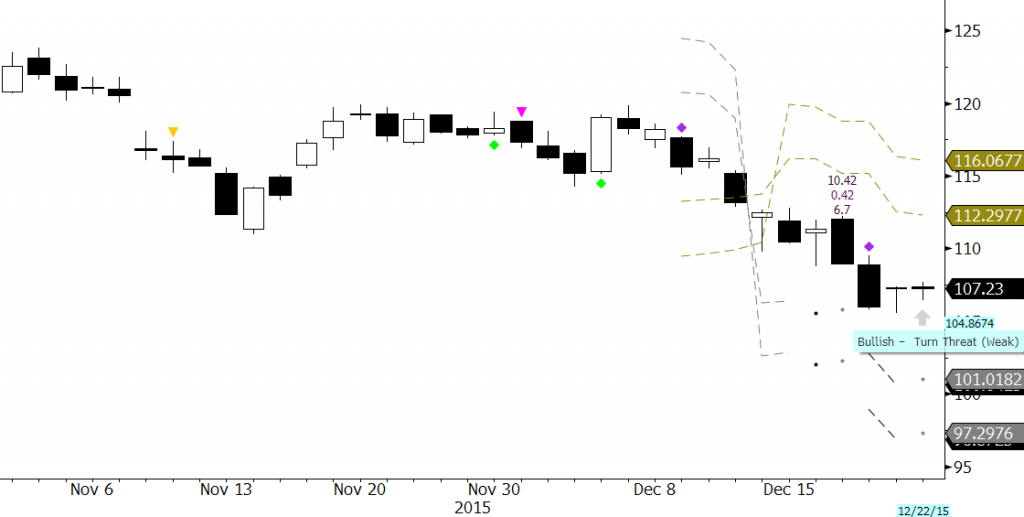
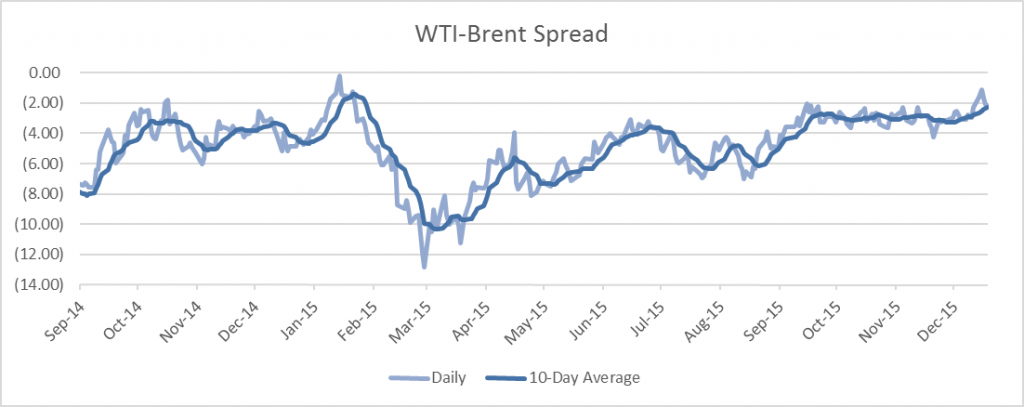
The U.S. rig count rose by 17 last week, and according to the EIA, U.S. crude oil supplies have reached 490.7 million barrels, the highest reported level for this time of year since 1930. In addition, the U.S.’s repeal of the 40-year oil export ban could ultimately encourage more pumping from domestic crude oil producers and narrow the WTI-Brent spread closer to parity in coming weeks. This is possibly good news for domestic producers, though it will take months and perhaps years before we will truly know. Overall, it is being reported that these factors could prolong the supply glut that is projected to last through the end of 2016 and possibly beyond.

The narrowing WTI-Brent spread is a being driven by WTI’s deeper contango versus Brent. In January 2015, the two grades were trading near parity, and it looks like this will be the case again in early 2016. This is encouraging for some U.S. producers as the spread could extend into positive territory where $2.60 is a confluent projection. However, longer-term, a narrow spread would likely lead to increased U.S. production, which would be negative for WTI. Conversely, a positive spread could encourage Brent producers to cutback, thus spurring both grades higher over the course of the longer-term. The key will be seeing whether or not the spread becomes positive and remains that way for the next few months. If so, it could lead to a longer-term shift in production strategies, and ultimately prices, world-wide.

WTI-Brent-Spread

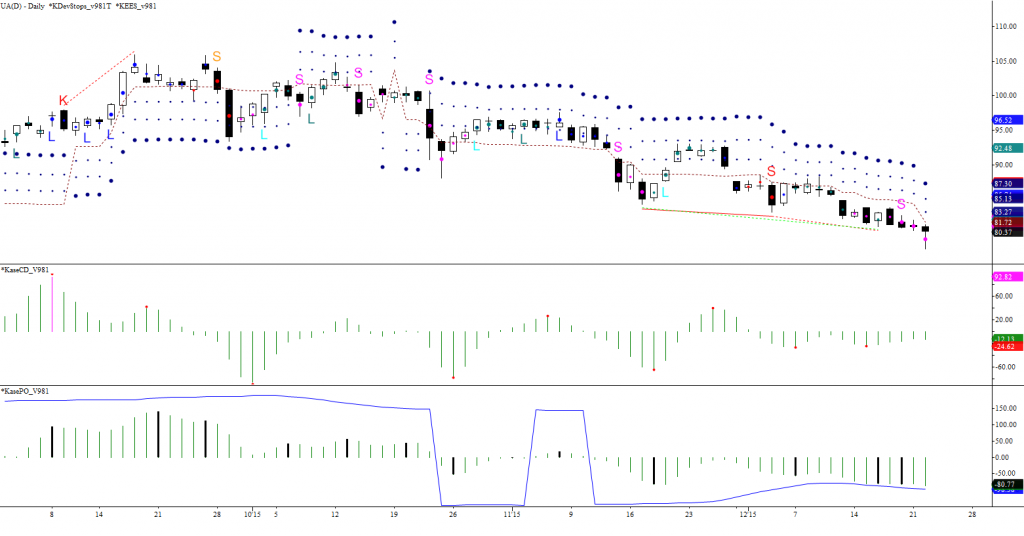
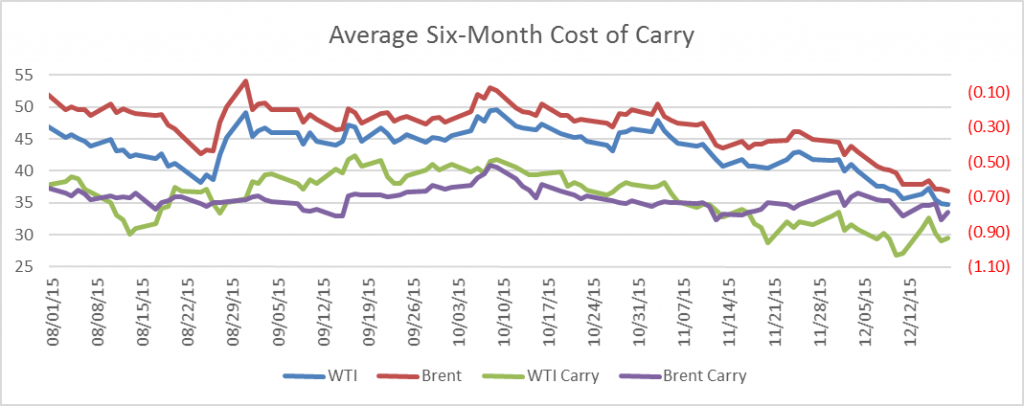
Another factor to watch right now is the calendar spreads and the cost of carry. The six-month average cost of carry narrowed a bit for WTI and Brent last week, but remains volatile. Typically, a carry above approximately ($0.50) encourages those with storage to buy oil now, store it, and then sell it at a later date when prices are higher (due to deep contango). This is fundamentally negative because supply rises. The six-month average costs of carry for WTI was ($0.93) and for Brent ($0.79) as of Friday’s settlement.

CostOfCarry

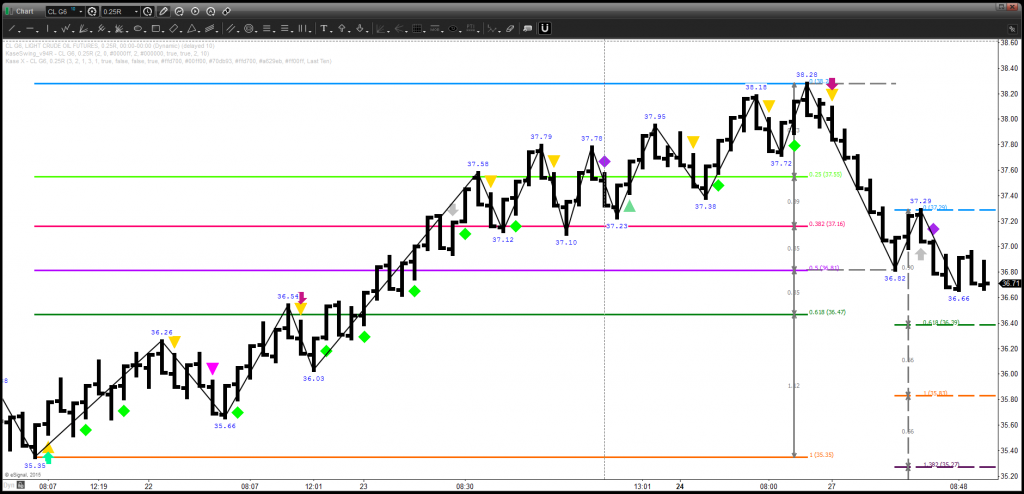
The technical agree with the negative fundamental and spread factors right now. Most momentum indicators are oversold and setup for divergence on the weekly and daily charts. Therefore, a correction might take place soon. However, until a swing low in both price and momentum are made look for the decline to continue. Over the next day or so we expect WTI to fall to $35.0 and for Brent to challenge $35.6. Both are crucial targets to connect to much lower levels as discussed in our full weekly analysis.

This is a brief analysis and outlook for the next day or so. Our weekly Crude Oil Commentary is a much more detailed and thorough energy price forecast. If you are interested in learning more, please sign up for a complimentary four-week trial.

By Dean Rogers

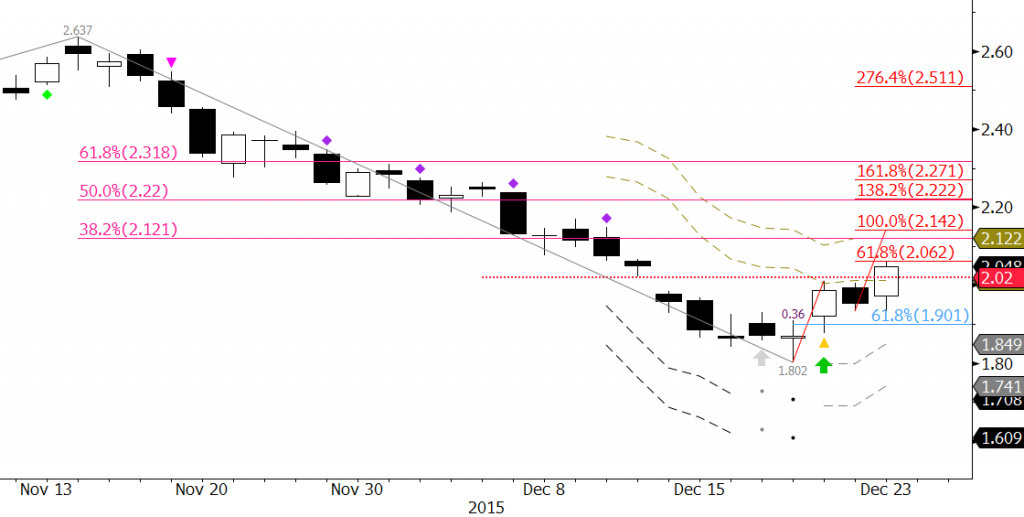
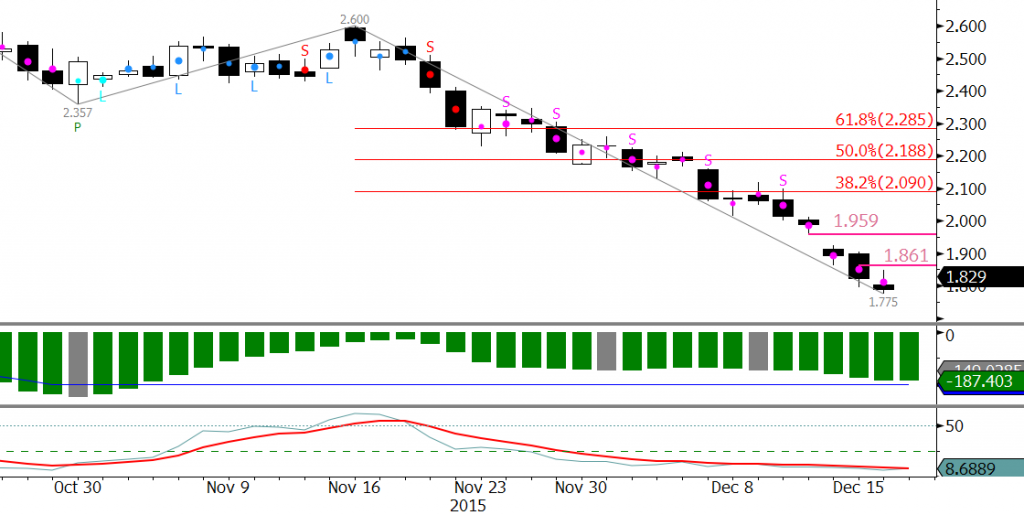
The outlook for natural gas is still bearish, and without support from weather or a strong increase in industrial demand, it will most likely remain that way. However, there are a few positive technical setups that indicate a small correction to $1.90 and even $1.959 might take place first.

Monday’s gap down from $1.959 still needs to be filled. This might be an exhaustion gap, but at this point it is looking more like a measuring gap that projects to $1.65. Wednesday’s morning star setup indicates prices could make a push for at least $1.90 to try and confirm the pattern. The Stochastic is deeply oversold (and has been for some time) and the KasePO is setup for bullish divergence as it nears oversold territory. If Wednesday’s $1.775 low holds, there is a good chance for the daily bullish KasePO divergence to be confirmed. Confirming the divergence, and confirming the morning star setup with a close over $1.90, would boost odds for filling the $1.959 gap.

NGF6 20151216

That said, longer-term odds still favor the decline and any move up will be corrective and hard pressed to overcome $1.959 without support from aforementioned external factors. Once the correction is complete (if it takes place at all), we expect prices to fall to $1.73 and $1.65.

This is a brief natural gas forecast for the next day or so. Our weekly Natural Gas Commentary is a much more detailed and thorough analysis. If you are interested in learning more, please sign up for a complimentary four week trial.

By Dean Rogers

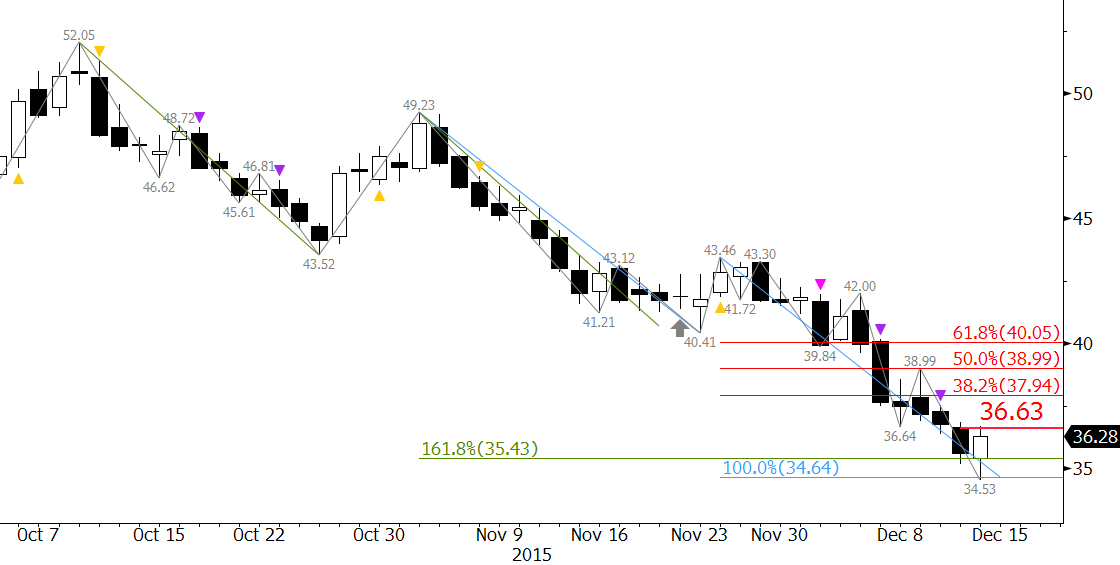
The darkest hour is just before the dawn. It is a phrase that most are familiar with that provides hope, even in the worst of circumstances. The outlook for WTI crude oil prices has been “dark” in recent weeks, and the longer-term outlook is still dim. However, December 14’s close over $36.13 provides a small shimmer of hope that a correction might finally be underway.

January WTI met a confluent and structurally crucial support target near $35.0 on December 14 and closed above December 11’s $36.13 midpoint to form a bullish piercing pattern. The piercing pattern is an early indication that a sustainable correction might finally be underway. A close over the pattern’s $36.63 confirmation point (December 11’s open) would call for at least $37.9, the 38 percent retracement from $43.46 to $34.53.

CLF6 20151214

The move up will most likely be corrective, but a substantial correction is long overdue. KaseX is not showing any signs of a turn yet, and the piercing pattern’s $36.63 confirmation point was tested and held. This dampens the likelihood of a reversal, but does not wipe out the potential completely. A close below $35.4 would negate the piercing pattern and call for the decline to continue towards the December 2008 perpetual swing low of $32.4.

Therefore, if the sun is going to rise $35.4 must hold and January WTI will need to close over $36.63 and then $37.9 within the next few days.

This is a brief analysis and outlook for the next day or so. Our weekly Crude Oil Commentary is a much more detailed and thorough energy price forecast. If you are interested in learning more, please sign up for a complimentary four week trial.

By Dean Rogers

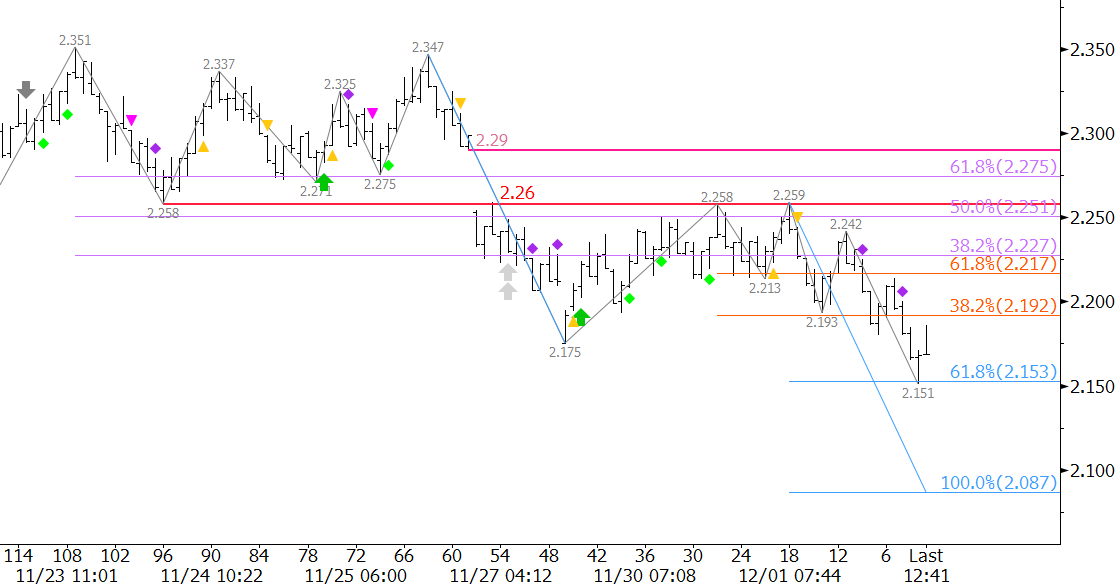
Natural gas is still looking for support from weather, but until cold temperatures arrive in key areas of the U.S. prices should continue to grind lower. The negative bias is confirmed by KaseX’s filtered short signal (purple diamonds).

Natural Gas

January futures met an important target at $2.15 on Wednesday. This was the 0.618 projection for the wave $2.347 – 2.175 – 2.259. A close below $2.15 would call for key support at $2.10, the 1.00 projection.

The importance of $2.15 indicates a correction might take place first, but look for resistance at $2.22 to hold. A close over $2.22 would call for $2.26 and possibly $2.30. A move higher than $2.30 is doubtful without support from weather.

This is a brief natural gas forecast for the next day or so. Our weekly Natural Gas Commentary is a much more detailed and thorough analysis. If you are interested in learning more, please sign up for a complimentary four week trial.

By Dean Rogers

For the past few weeks gasoline futures rose in a dramatic fashion and lent some support to underlying WTI and Brent futures prices. However, a few bearish technical factors indicate the move up is probably complete and that a major test of support is now underway.

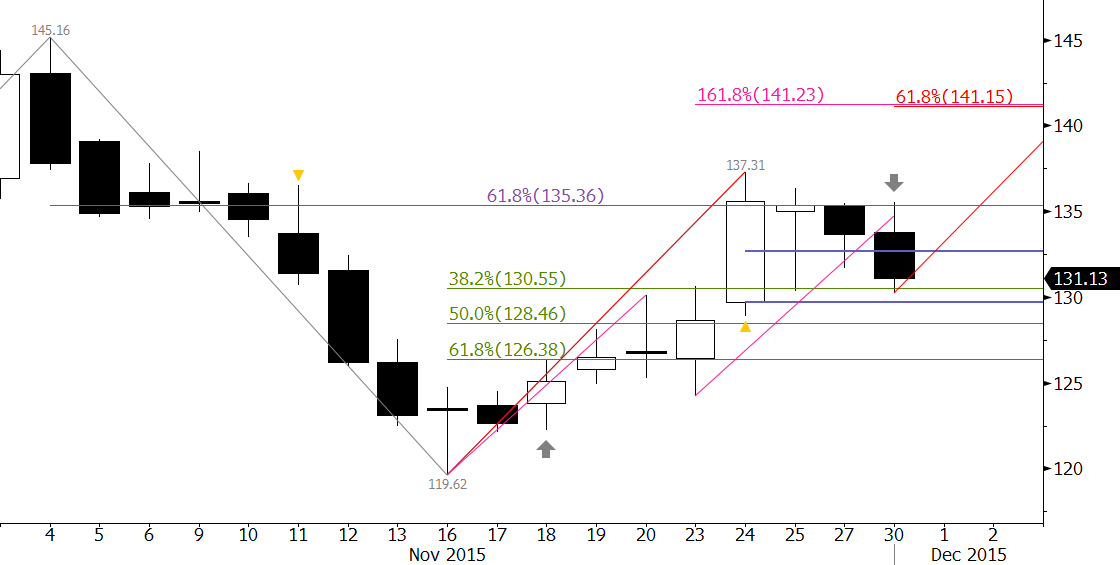
January gasoline futures stalled at the crucial 62 percent retracement of the decline from $1.4516 to $1.1962. In addition, Monday’s $1.3069 settle completed an evening star and hammer candlestick pattern and a moderately bearish overbought signal on KaseX (gray arrow). All three factors indicate the decline should continue.

XBF6 20151130

The pullback has retraced 38 percent of the move up from $1.1962 to $1.3731 so far. A close below $1.2972 will confirm the evening star and hammer and call for at least $1.285 and very likely $1.264, the 50 and 62 percent retracements, respectively. These are also confluent intraday wave projections.

From a technical standpoint, the move down is corrective of the move up until there is a close below $1.264. Odds for a move of this magnitude over the next week or so are 65 percent.

Look for resistance at $1.33 to hold. A close over $1.354 would be positive and open the way for $1.412 and higher.

This is a brief analysis and outlook for the next day or so. Our weekly Crude Oil Commentary is a much more detailed and thorough energy price forecast. If you are interested, please sign up for a complimentary four week trial.

Kase’s president Cynthia A. Kase is featured in a podcast interview with Marie Grace Berg of Today’s Leading Women.

Listen to Ms. Kase’s interview on iTunes and give it a rating, or click the link below to listen on the Today’s Leading Women website.

Episode 634: Learn Trading and Forecasting Techniques with Cynthia Kase

Cynthia-Kase-of-Kase-Company-e1447283745788


By Dean Rogers

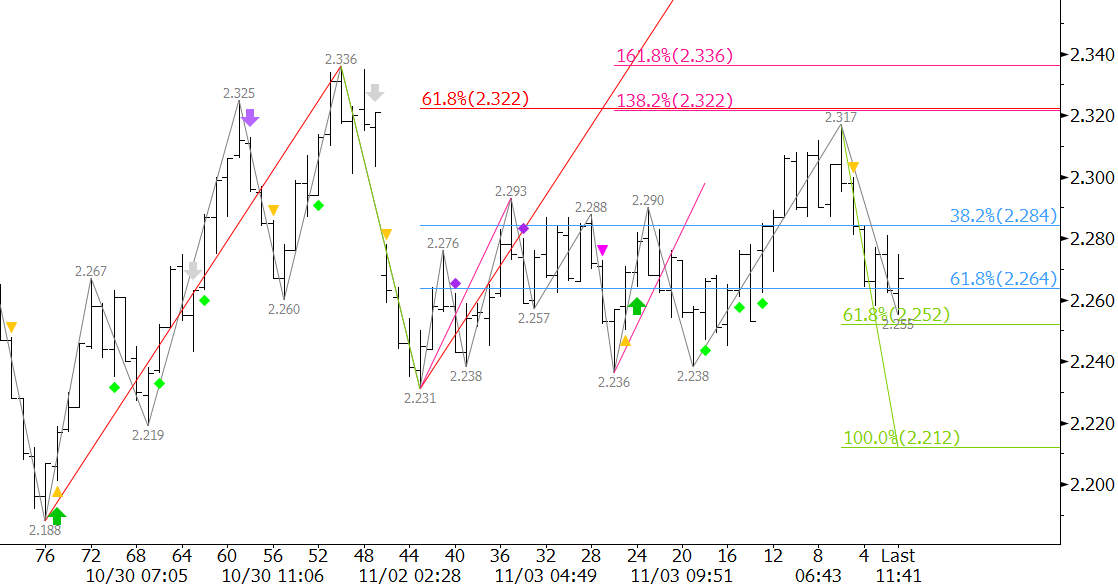
Natural gas cautiously rose to $2.317 to fulfill the smaller than (0.618) projection for the wave $2.188 – 2.336 – 2.231. Typically, a move to $2.38 would now be expected because waves that meet the 0.618 projection normally extend to at least the equal to (1.00) projection. The pullback to $2.255 is a bit worrisome, but until the $2.231 swing low is taken out odds favor of a move to $2.38. This is a crucial target because $2.38 is the 38 percent retracement from $2.78 to $2.188 and makes a connection to $2.48 where last week’s gap would be filled.

NGZ5 20151104

KaseX warned that the decline from $2.317 would extend (yellow triangle), and as stated, support at $2.25 is already being challenged. A move below $2.231 would take out the wave up from $2.188 and its projections to $2.38 and higher. This would in turn shift odds back in favor of a decline to $2.11 to fulfill the requirements of the textbook five wave pattern down from $3.391 as discussed last week.

This is a brief natural gas forecast ahead of tomorrow’s EIA report. Our weekly Natural Gas Commentary is a much more detailed and thorough analysis. If you are interested in learning more, please sign up for a complimentary four week trial.

By Dean Rogers

Last week several top refiners reported a jump in their third quarter earnings compared to a year ago. Attractive crack spreads and refining margins due to lower oil prices and healthy demand for gasoline have helped refiners pump in profits. In addition, last week’s rise in oil prices, which was partially attributed to a quick turnaround in the refinery maintenance season, has helped to stabilize gasoline futures and open the way for a test of key resistance near $1.43.

December gasoline futures have oscillated in a trading range bound between approximately $1.26 and $1.43 since early September. The most recent move up from $1.26 overcame resistance at $1.36 and is now poised to test the upper boundary of the range at $1.43. This is the 2.764 projection for the small wave $1.2621 – 1.323 – 1.2627, the 0.618 projection for the wave $1.1756 – 1.4604 – 1.2621, and the 38 percent retracement of the decline from $1.8392 to $1.1756. There is a good chance that $1.43 will hold, but a close over this would open the way for at least $1.55.

XBZ5 20151102

The Kase Easy Entry System (KEES), which is based upon a sophisticated algorithm that accounts for multiple momentum indicators, bar lengths, swings, and bar structure, confirms the positive bias in the near term. The blue dot indicates that the underlying indicators and bar lengths are permissioned for long trades to be taken.

Prices are expected to reach at least $1.43 before another turn lower to test support takes place. For now, look for immediate support at $1.31 and for key support at $1.26. A close below the latter would call for the late August low of $1.1756 to be challenged.

This is a brief analysis and outlook for the next day or so. Our weekly Crude Oil Commentary is a much more detailed and thorough energy price forecast. If you are interested, please sign up for a complimentary four week trial.

By Dean Rogers

December WTI’s wave $39.22 – 50.89 – 44.31, which met its 0.618 projection at $51.42, has been taken out by the $43.64 swing low. Consequently a technical failure of the move up has taken place and odds have shifted in favor of a continued decline. Look for $43.0 tomorrow and very likely $42.5 over the next few days. A close below $42.5 would confirm the negative outlook and technical failure. There is an outside chance that the support trend line will hold. Look for resistance at $45.4 and $46.5.

CLZ5 20151026

This is a brief analysis and outlook for the next day or so. Our weekly Crude Oil Commentary is a much more detailed and thorough energy price forecast. If you are interested, please sign up for a complimentary four week trial.

By Dean Rogers

This is the time of year when everyone is looking for a bottom and pre-winter rally for natural gas. The logic and seasonal timing make sense, but picking bottoms is a dangerous game. Those that successfully time the bottom are more lucky than good. The best that most mere mortals can hope for is to be prepared for the turn so that they can react in an effective manner that fits their goals, strategy, and risk appetite.

This is why it is important to have a forecast and directional opinion (and yes, sideways is a direction) about the market in addition to a set of reliable indicators like Kase StatWare or KaseX to time entries and exits. The forecast is the framework for the market that lets you know where key support and resistance are and when you can expect correction and potential trend reversal. Indicators tell you when to get in, where to place stops, and when to get out.

For instance, $2.40 was major support for November natural gas. This was a highly confluent target, and we had discussed this level as a potential stalling point for many weeks (even months) leading up to the decline to $2.403 on October 2. However, the subsequent move up was shallow, choppy, and corrective. Long trades could have been taken on shorter bar lengths during the corrective move up, but in our detailed weekly forecasts and mid-week blog updates we anticipated another decline and test of $2.40 because the market was struggling to overcome key resistance levels at $2.48 and $2.59.

November fell to $2.41 on October 16 and started to bounce again. The move stalled at $2.50 on Tuesday, October 20 and prices fell to new lows for November and the winter contracts on Wednesday, October 21.

NGX5 20151021

$2.40 has held so far on a closing basis, but a sustained close below this level will open the way for at least $2.33, the 1.00 projection for the wave $2.578 – 2.41 – 2.499 and very likely $2.27. The latter is a confluent objective for the waves down from $2.859, $2.72, and $2.578 making it the next potential point at which a bottom could be made.

Most technical factors are negative and there is little evidence that the decline is going to stall. However, the importance of support at $2.33 and especially $2.27 indicate that we should be prepared for at least another correction and a potential bottom soon. Keep a close eye on your indicators to tell you when to time your entries and watch for closes above key resistance levels to confirm the move down has ended.

For now, initial resistance is $2.45 and key resistance, for the near term, is $2.50.

This is a brief natural gas forecast ahead of tomorrow’s EIA report. Our weekly Natural Gas Commentary is a much more detailed and thorough analysis. If you are interested in learning more, please sign up for a complimentary four week trial.