
Kase ezHedge
A Simpler Way to Hedge Energy. Statistically Grounded.
Kase ezHedge is a passive, volume-averaging hedge program designed specifically for energy consumers. Each day, a single color-coded signal tells you exactly when to hedge, when to wait, and precisely how much volume to execute — automatically. No interpretation required. Historically, ezHedge has outperformed both dollar cost averaging and unhedged market prices with significantly lower cost swings.
Built for Energy Consumers of Every Size
Kase ezHedge is designed for any organization that purchases energy and wants a systematic, low-effort approach to managing price risk. It can be tailored to fit individual volumes and risk appetite, and is suitable for both small and large consumers:
Utilities and Power Generators
Systematic natural gas procurement hedging for utilities with large, ongoing fuel purchase requirements and structured risk management mandates.
Large Industrial Consumers
A disciplined, rule-based hedge program for manufacturers, chemical producers, and other energy-intensive industrials managing fuel and feedstock cost exposure.
Airlines and Transportation Companies
Fuel cost risk management through a volume-averaging approach that avoids the concentration risk of calendar-based hedging programs.
Commercial and Institutional Consumers
Suitable for hospitals, universities, municipalities, and other large institutional energy purchasers seeking a structured approach to natural gas and fuel cost management.
Small and Mid-Size Energy Users
Including restaurant chains, food processors, and regional businesses — ezHedge scales to fit exposures as small as 5,000 barrels per month or 50,000 MMBtu per month equivalents.
Finance and Procurement Teams
A mechanical, rule-based system that is easy to monitor, audit, and report — supporting internal governance and board-level commodity risk oversight.
Better Than Dollar Cost Averaging. Simpler Than Active Hedging.
Dollar cost averaging — hedging a fixed percentage of volume on a fixed calendar schedule — is a widely used approach for energy consumers. But it consistently produces losses relative to market prices over time, primarily due to contango in forward curves. In bull markets, calendar-based programs can produce severe cost swings that undermine the purpose of hedging altogether.
Kase ezHedge takes a fundamentally different approach. Rather than hedging on a fixed schedule regardless of price level, ezHedge evaluates the market’s position relative to statistically derived price zones — and tells you precisely when to hedge, when to accumulate volume for future hedging, and when to wait. Critically, it does not just tell you whether to hedge: it tells you the exact volume to execute on each day a hedge is warranted, derived directly from the price zone and the running accumulation count.
The result is a program that has historically outperformed both dollar cost averaging and unhedged market prices, with significantly lower cost swings across market cycles — and that can be followed mechanically without ongoing analytical judgment or active market monitoring.
How ezHedge Works
ezHedge breaks market prices into five zones based on percentile levels across a range of lookback periods. Each day, a color-coded dot is plotted on the day’s closing price. The dot tells the hedger not just whether to act — but exactly how much volume to hedge or accumulate that day:
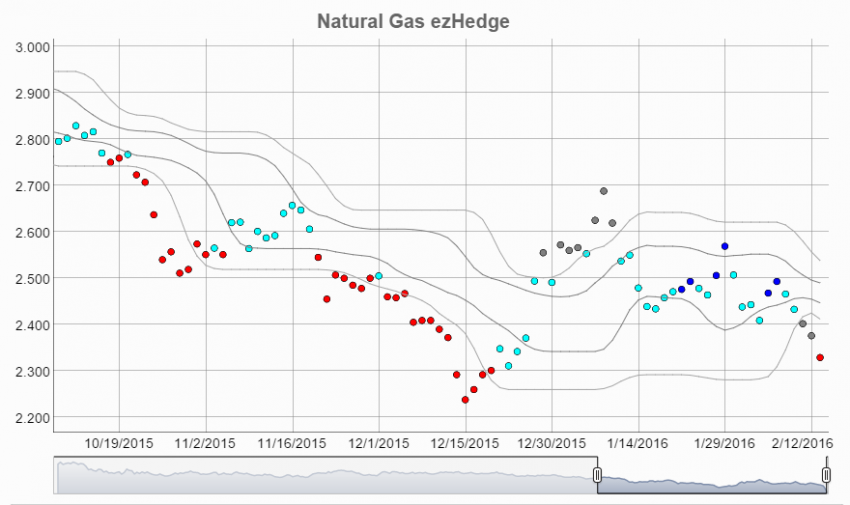
Kase ezHedge — color-coded hedge signal dots plotted on daily closing prices across five statistically derived price zones, each specifying the precise volume action for that day.
Five Price Zones — Exact Volume Guidance at Every Level
The model divides the price environment into five zones. The zone in which price is trading determines the number of volume points associated with each hedging day — directly translating to a specific hedge volume for your organization:
- Upper Zone — no hedging; prices may be too high to justify continued hedging
- Zone 1 — one point of hedge volume accumulated or executed per qualifying day
- Zone 2 — two points of hedge volume accumulated or executed per qualifying day
- Zone 3 — three points of hedge volume accumulated or executed per qualifying day
- Lower Zone — no hedging; prices are low enough to signal possible further downside
Each point corresponds to a specific percentage of your total hedge volume. The deeper into the middle zones price trades, the larger the volume to be hedged on that day — automatically scaling your hedge execution to the statistical favorability of the price level.
Four Dot Colors — Your Exact Daily Action
Each day is assigned one of four dot colors derived from cycle analysis relative to the current price zone. The dot tells the hedger the precise action to take — including the exact volume to execute when a hedge is called for:
- Blue dot — hedge now; execute all previously accumulated volume plus the current day’s zone volume immediately
- Light blue dot — accumulate; add today’s zone points to the running count but do not execute yet
- Gray dot — hold; maintain the current accumulation count at its existing level — do not add and do not reset
- Red dot — reset; do not hedge and set any accumulated volume to zero
The program defaults to hedging 18 months forward, with alternative six-month and twelve-month programs available. ezHedge is calibrated to each subscriber’s actual exposure volumes — so every dot translates directly into a specific number of contracts or MMBtu to act on.
Four Statistical Principles. One Disciplined System.
Kase ezHedge is based on cycle analysis and four foundational principles that govern when hedging is and is not allowed. Two principles suspend hedging; two permit it. The time periods associated with each cycle have been determined through computer optimization:
When Hedging Is Not Allowed
Principle 1 — Market Peak Risk: After a market has risen for an extended period, the statistical odds increase that it will peak soon and turn to the downside. Prices in the upper zone following a prolonged rally are likely to fall — making hedging at those levels statistically unfavorable. Hedging is suspended.
Principle 2 — Downside Continuation: If a market has fallen for a certain number of days and prices are statistically low, the odds favor continued downside — meaning even more favorable prices may be available shortly. Hedging is postponed to avoid locking in costs prematurely.
When Hedging Is Allowed
Principle 3 — Low Point and Recovery: After a market has reached a statistical low and begins to rise for a defined period, the odds favor continued upside. Prices are likely heading higher — making the current level a statistically favorable point for consumers to hedge. Hedging is permitted.
Principle 4 — Failed Peak Reversal: Should Principle 1 fail — meaning the anticipated market peak does not materialize and prices swing back upward — the suspension of hedging is lifted and hedging is again allowed at current levels.
Simple to Follow. Statistically Grounded. Proven to Outperform.
Kase ezHedge combines the rigor of statistical cycle analysis with a display so straightforward it can be followed mechanically — without requiring ongoing market expertise or active management:
Tells You Exactly How Much to Hedge
ezHedge does not just signal when to hedge — it specifies the precise volume to execute each day based on the price zone and accumulation count, calibrated to your actual exposure.
Outperforms Dollar Cost Averaging
ezHedge has historically produced gains relative to both dollar cost averaging and unhedged market prices — with significantly lower cost swings across market cycles.
No Interpretation Required
A single color-coded dot on each day’s closing price gives the complete action for that day — including whether to hedge and how much. The system is designed to be followed mechanically.
Tailored to Your Volumes
ezHedge is calibrated to each consumer’s actual exposure volumes — ensuring every dot signal translates directly into a specific, actionable hedge volume for your organization.
Flexible Hedge Horizons
Default program hedges 18 months forward. Six-month and twelve-month programs are available for consumers with shorter exposure windows or more active hedge management preferences.
Auditable and Governance-Ready
The fully rule-based, mechanical framework produces a clear, auditable record of every signal and action — supporting internal governance, compliance, and board reporting requirements.
Subscription Options
ezHedge Subscription
Pricing is based on the number of users and annual hedge contract volume. Contact us to discuss which tier fits your organization’s volumes and hedging requirements.
| Users | Under 200 contracts/yr | 200–800 contracts/yr | Over 800 contracts/yr |
|---|---|---|---|
| 1 user | $1,850/mo | $3,400/mo | $4,900/mo |
| 2 users | $3,500/mo | $5,450/mo | $8,200/mo |
| 3 users | $4,850/mo | $8,050/mo | $10,700/mo |
| 4 users | $6,000/mo | $10,400/mo | $12,500/mo |
Included With Every Subscription
Every ezHedge subscription includes a complimentary subscription to the Kase Commentary on Crude Oil or Natural Gas — giving subscribers independent weekly technical analysis of the same market their ezHedge program covers.
Contact us to discuss your organization’s exposure volumes and which tier is the right fit.
Statistical Foundations. Since 1992.
Kase ezHedge is built on the same cycle analysis and statistical methodology underlying all of Kase and Company’s analytical work — applied specifically to the hedging decision for energy consumers. The core analytical foundations include:
- Cycle analysis — identification of statistically meaningful market cycle periods through computer optimization, establishing the time parameters for each of the four hedging principles
- Percentile zone calculation — price zones derived from percentile levels across a range of lookback periods, identifying statistically high, low, and neutral price environments
- Exact volume specification — zone-based point accumulation system that translates directly into precise hedge volumes calibrated to each subscriber’s actual exposure
- Volume-averaging framework — a systematic accumulation and execution approach that distributes hedge volume across statistically favorable price levels rather than fixed calendar dates
- Contango-aware design — specifically structured to avoid the losses that dollar cost averaging programs systematically incur in contango market environments
- Backtested and optimized — cycle time periods and zone parameters established through historical optimization, with track record results available upon request
Kase ezHedge is a statistical decision support tool designed to inform and support each client’s own hedge execution decisions. It is not to be construed as investment advice, trading recommendations, or consulting. All hedging decisions remain the responsibility of the individual organization and its advisors.
Request a No-Charge Trial
See how Kase ezHedge compares to your current hedging approach — calibrated to your actual volumes and market exposure, at no charge and no obligation.